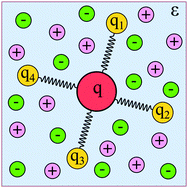
In this article, I summarize my theoretical developments in the statistical field theory of salt solutions of zwitterionic and multipolar molecules. Based on the Hubbard–Stratonovich integral transformation, I represent configuration integrals of dilute salt solutions of zwitterionic and multipolar molecules in the form of functional integrals over the space-dependent fluctuating electrostatic potential. In the mean-field approximation, for both cases, I derive integro-differential self-consistent field equations for the electrostatic potential, generated by the external charges in solutions media, which generalize the classical Poisson–Boltzmann equation. Using the obtained equations, in the linear approximation, I derive for the both cases a general expression for the electrostatic potential of a point-like test ion, expressed through certain screening functions. I derive an analytical expression for the electrostatic potential of the point-like test ion in a salt zwitterionic solution, generalizing the well known Debye–Hueckel potential. In the salt-free solution case, I obtain analytical expressions for the local dielectric permittivity around the point-like test ion and its effective solvation radius. For the case of salt solutions of multipolar molecules, I find a new oscillating behavior of the electrostatic field potential of the point-like test ion at long distances, which is caused by the nonzero quadrupole moments of the multipolar molecules. I obtain a general expression for the average quadrupolar length of a multipolar solute. Using the random phase approximation (RPA), I derive general expressions for the excess free energy of bulk salt solutions of zwitterionic and multipolar molecules and analyze the limiting regimes resulting from them. I generalize the salt zwitterionic solution theory for the case when several kinds of zwitterions are dissolved in the solution. In this case, within the RPA, I obtain a general expression for the solvation energy of the test zwitterion. Finally, I demonstrate how to take a systematic account of the excluded volume correlations between multipolar molecules in addition to their electrostatic correlations. I believe that the formulated findings could be useful for the future theoretical models of the real ion–molecular solutions, such as salt solutions of micellar aggregates, metal–organic complexes, proteins, betaines, etc.